Summary
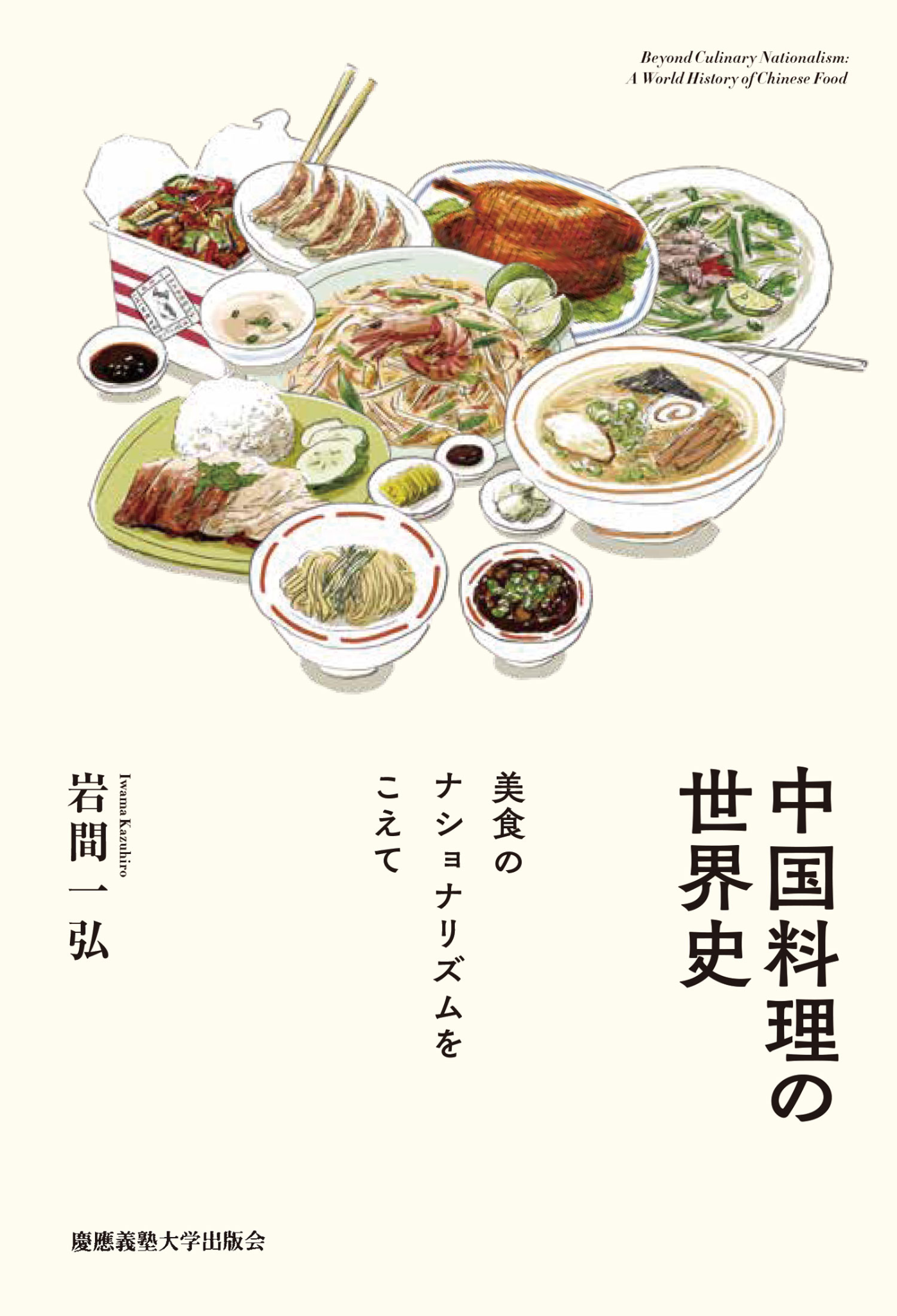
Ramen and gyoza have become indispensable parts of the Japanese diet. Across Asia, meanwhile, Chinese dishes have been transformed into distinctive “national foods” in the societies that adopted them. In this episode, we welcome Professor Kazuhiro Iwama of the Faculty of Letters at Keio University to discuss his book A Global History of Chinese Cuisine: Beyond Culinary Nationalism (Keio University Press, 2021).
Our conversation ranges from the questions that first emerged during his year in Shanghai to his fieldwork experiences traveling, eating, and conducting research across Southeast Asia, as well as the regional diversity within China that the book could not fully explore. Through a series of concrete episodes, we ask how food—one of the most familiar points of entry into another society—can help us approach China with greater openness and nuance.
Beginning with Dumplings: Food as a Point of Entry
The conversation begins with a plate of dumplings. In the interviewer’s family home, dumplings meant boiled dumplings. Boiled or pan-fried: this seemingly simple distinction can carry surprisingly deep significance. Reading Iwama’s book brought back memories of the interviewer’s own experiences. The straightforward question, “Why did my family eat boiled dumplings?” leads to a larger question about understanding others—in this case, understanding China—through food.
Food is not merely delicious or enjoyable as a subject. It also holds deeper academic significance. Iwama specializes in the modern and contemporary history of East Asia, the history of culinary and cultural exchange, and Chinese urban history. The central keyword running through his research is “Chinese cuisine.”
Encountering Another China in Shanghai: A Turn toward Food-Culture Research
The turning point came in 2010. Through a program offered by the business-oriented university where he was then teaching, Iwama spent a year studying in Shanghai. At the time, the city was at the height of a boom in Japanese corporate investment. The atmosphere was so enthusiastic that people even claimed that failing to enter the Chinese market was itself a risk. Looking back from the present, after the dramatic changes of the past fifteen years, it is difficult to imagine the intensity of that moment.
Through his interactions with people working in Japanese restaurant businesses in Shanghai, Iwama encountered forms of knowledge and perspectives on China that differed completely from his own background in history and urban culture. This led him to question whether his existing understanding was truly adequate. Perhaps looking at China through food—and thinking about Asian history through food—could offer a valuable approach. It was during this period that the possibility first occurred to him.
Iwama has been studying food for only about fifteen years. Before that, he had spent far longer researching the history of Shanghai. He therefore describes himself as having studied intensely in an effort to catch up in this new field.
His starting point was an interest in urban life. Of the three essentials of clothing, food, and shelter, food is perhaps the most approachable. Yet that accessibility also creates difficulties. Food is discussed by people from an extraordinary range of disciplines, each from a different perspective. Iwama is interested not primarily in food itself, but in viewing Chinese and Asian societies through food. As a result, he sometimes finds it difficult to bring his questions into productive conversation with those of other fields. Even so, there remains considerable room to develop new ways of seeing China and Asia. It is this potential that makes the research so rewarding.
Is Ramen Exceptional? Chinese Cuisine as “National Food” across Asia
Food has attracted growing interest within academia. Discussions at conferences are often especially lively because almost everyone has a personal experience or observation to contribute. Specialized research continues to expand, and the English-speaking academic world alone has four or five journals devoted specifically to food studies. The field is highly rewarding, although its growth also brings an increasingly busy range of related activities.
Historically, a major strand of food research focused on food production and distribution within economic history. Iwama, however, chose to study cuisine rather than food as a commodity. Examining cooking and cuisine from the perspective of the humanities, social sciences, and history—rather than from the viewpoints of professional cooking, home economics, or literature—revealed a wide range of previously overlooked phenomena.
The central subject of the book is how Chinese cuisine traveled around the world and became incorporated into the “national cuisines” of different countries. Japanese Chinese cuisine has often been described as both firmly established and uniquely distinctive. One familiar argument held that ramen, although derived from Chinese cuisine, became a Japanese national food, demonstrating the Japanese capacity to absorb foreign culture and make it their own.
In reality, however, Chinese dishes have become national foods throughout Asia, often to the point that their Chinese origins have largely been forgotten. Examples include pad Thai in Thailand, phở in Vietnam, and Hainanese chicken rice in Singapore. Rather than treating Japan’s reception of foreign culture as exceptional, the book places it within the broader experience of Asian societies that adopted elements of Chinese culture and transformed them into something of their own. According to Iwama, this is what he most wanted the book to demonstrate.
The key factor is “distance” from China. In parts of Asia that are geographically and culturally close to China, Chinese dishes tend to become national foods, while their Chinese roots gradually fade from public awareness. Jajangmyeon is a national favorite familiar to nearly everyone in South Korea; the same can be said of ramen in Japan, pad Thai in Thailand, and phở in Vietnam. In Europe and North America, by contrast, Chinese food may be widely accepted, but it generally remains within the category of ethnic cuisine.
Political tensions and conflicts can also cast a faint shadow over food. One of food’s strengths is that, as it travels, it often becomes detached—or “bleached”—from its original historical and political background. Yet this process is never complete. When relations between Japan and China deteriorate, people may express concern for employees working in Chinese restaurants, while Chinatowns may experience fewer visitors. Food is relatively independent of politics, yet political shadows occasionally fall across it. This is the subtle distance that food maintains from the political sphere.
Walking, Eating, and Writing: The Joy of Fieldwork and the Limits of Historical Sources
What was the most difficult part of writing the book? Iwama’s answer is unexpected: he did not find the process especially difficult; he enjoyed it.
He visited Southeast Asian countries one by one, consulted the available literature, and ate local Chinese food, repeating the process again and again. It was a fieldwork-centered project, and he threw himself wholeheartedly into this first attempt at researching food.
The real difficulty lay in collecting previous studies and historical sources. Unlike China and Japan, many parts of Southeast Asia have relatively few surviving historical materials. Iwama often searched extensively only to find that the sources he hoped for simply did not exist. This obstacle had not been anticipated. After all, the project itself began with the surprised realization that Chinese cuisine could be found even in countries where he had never expected to encounter it.
Around the time the book was published, interest in Chinese cuisines around the world began to grow. Related books appeared, and the subject even began to feature in the Japanese travel-guide series Globe-Trotter Travel Guidebook. Iwama reflects that the research was so fascinating precisely because he had begun from a position of knowing almost nothing.
What Remains Unknown after the Book Is Finished
This program asks every guest the same question: rather than focusing only on what the book has clarified, what did it leave unresolved, and what important questions remain for future research?
Iwama’s answer is clear. Although the book provides an extensive discussion of Chinese cuisine outside China, its treatment of China itself is comparatively limited. The major omission is regional cuisine.
China is home to fifty-five officially recognized ethnic minority groups and has a population of approximately 1.4 billion. Regional differences are immense. They extend far beyond the familiar contrast between wheat in the north and rice in the south. Regions differ in their use of chili peppers and other spices, their local comfort foods, and even what some regard as fundamentally distinct culinary systems.
Moreover, the province has become a powerful unit in contemporary China, and there is an increasingly visible tendency for individual provinces to define and promote their own cuisines. This is also the age of intangible cultural heritage. Cuisine and many other cultural practices are being designated as intangible cultural heritage and promoted as tourism resources to stimulate domestic travel.
“I was barely able to portray any of this,” Iwama acknowledges. It is a difficult area for foreign researchers to enter. Yet just as the countries of Southeast Asia had to be visited one by one, China’s provinces and regions also possess their own distinct circumstances. Exploring them in greater depth could significantly change not only our understanding of Chinese cuisine, but also our understanding of China itself. There remains enormous room for further research on Chinese cuisine and Chinese culture in Japan.
Food as Another Doorway
Understanding Chinese food and understanding China may sound similar, but they are not the same thing. Acknowledging the difficulty of the question, Iwama observes that Japanese views of China tend to concentrate on a limited number of fields and issues. Opinion surveys show that favorable views of China in Japan are exceptionally low by global standards. Yet these impressions may not arise from an engagement with China’s many regions, cultures, and cuisines. Instead, they may be the result of seeing only one particular version of China.
China is undeniably a highly political country, and relations between Japan and China remain unstable and burdened by numerous problems. At the same time, however, there is another Chinese world that receives little attention—a world quite different from the familiar image of a stern or intimidating China. Many people who have engaged closely with China are drawn to this other world, yet it remains difficult to see through news coverage in Japan alone.
Food is especially well suited to making this world visible. It offers another doorway into the many dimensions of China. The conversation concludes with the hope that, through food, we may begin to see this other Chinese world.