In September 2026, I visited Guangzhou and was able to observe institutions such as the Comprehensive Social Governance Center (社会治安总合治理中心 hereinafter referred to as the "Comprehensive Governance Center"), the Community Residents' Committee, and Party-Mass Service Centers(党群服务中心). In grassroots governance, the Secretary of the community Party organization serves as the director of both the Comprehensive Governance Center and the Grid-based Service Management Center. The Comprehensive Governance Center is positioned as a unified platform functioning as a one-stop service for grassroots residents. However, when actually visiting district-level and community-level Comprehensive Governance Centers, the transparent automatic doors were closed, creating an atmosphere that did not feel welcoming to general citizens. In contrast, the Party-Mass Service Centers had open doors and a welcoming atmosphere, allowing us to enter several of them, giving the impression of service bases that are more open to the public.
What does it signify that Party-Mass Service Centers, based on Party organizations, are increasing their presence alongside subdistrict communities and residents' committees led by the Party in grassroots governance? This paper interprets the establishment of Party-Mass Service Centers as a process through which Party organizations, previously marginalized in grassroots governance, seize the initiative from government administration. To demonstrate this, this paper explains: the complication of lines of command in grassroots governance; the intention of previously marginalized Party organizations to seek reconstruction; and the establishment of Party-Mass Service Centers expected to subsume administrative and living services to play an active role. Finally, based on operational issues, this paper considers the challenges and limits of the Party's ability to continuously provide satisfactory services to the public in order to maintain its leading position in grassroots governance.
1. Complicating Grassroots Governance
The Xi Jinping administration has made social stability one of its top priorities and implemented numerous measures regarding grassroots governance. As a result, China's grassroots governance system today features a mixture of multiple leadership systems, making it increasingly complex (Nakaoka, 2026).
In the 1980s, due to the collapse of the "work-unit (danwei) society," individuals lost their connection to the state and became atomized. Amidst this, in 1986, the Ministry of Civil Affairs introduced the concept of "community (shequ)" into urban management and proposed developing community services in urban areas (Xiang & Hua, 2019, p. 108). The following year, in 1987, community services officially began (Xia, 2019, p. 24). The underlying goal was social stability, with service provision at the core of policies targeting communities.
From 1991, community-related policies entered the "community construction" phase. The Department of Grassroots Political Power Construction was established under the Ministry of Civil Affairs. Under the ministry's jurisdiction, the focus of community work shifted from service provision to community political power construction, and by the late 1990s, community construction and management became the main theme.
Beginning in 2000, community construction driven by the Ministry of Civil Affairs, its subordinate subdistrict offices (jiedao banshichu), and residents' committees (jumin weiyuanhui) began in earnest. Within these community management organizations, Party committees or work committees remained defined as the core of leadership.
Under the Xi Jinping administration starting in 2012, community work entered the "community governance (shequ zhili)" phase. The Third Plenary Session of the 18th Central Committee in 2013 called for innovation in the social governance system, instructing the utilization of grid-based management, the sound development of grassroots comprehensive service management platforms, and the strengthening of comprehensive social governance. At that time, two lines of command coexisted in parallel: the government (administrative) line of "Municipal Government — Subdistrict Office — Community Residents' Committee" and the Party line of "Municipal Party Committee — Municipal Party Committee Subdistrict Work Committee — Community Residents' Committee".
In 2016, to strengthen social security governance and reinforce the Party's position as the ruling party, the "Specifications for the Construction and Management of Comprehensive Social Governance Centers" was issued, requiring the construction and management of Comprehensive Governance Centers across five levels: province, city, county, township/subdistrict, and village/community. Consequently, a "security" mission was added to community governance.
In 2019, under the "Regulations on the Work of the Political and Legal Affairs Commission of the Communist Party of China," Comprehensive Governance Centers were placed under the command system of the Political and Legal Affairs Commission. As a result, in addition to the traditional administrative and Party lines, a third line of command—"Municipal Party Committee Political and Legal Affairs Commission — Subdistrict Political and Legal Affairs Member"—was added to community governance.
In 2023, community governance shifted significantly from its existing trajectory. Through national institutional reforms, the Social Work Department of the Party Central Committee was newly established, absorbing the responsibilities for grassroots governance and grassroots political power construction previously held by the Ministry of Civil Affairs. Thus, a fourth line—the Municipal Social Work Department system—became involved in the "Subdistrict Office — Community Residents' Committee" line. The primary pillars of the Social Work Department regarding grassroots work are "party-building led grassroots governance and grassroots political power construction" and "construction of volunteer services and social work talent teams" (Social Work Department of the CPC Central Committee). Unlike the Party committee and Political and Legal Affairs Commission systems, which interacted as command lines built into government administration, the Social Work Department system adopted a new approach aimed at securing grassroots governance stability through the construction of grassroots Party organizations.
As the main theme of grassroots governance transitioned from service provision to community political power construction, community management, community governance, and public security maintenance, the lines of command continued to increase, making the grassroots governance system multi-layered and complex.
2. Transformation of Party Organizations in Grassroots Governance: From Marginalized Party Organizations to Seizing Leadership
As demonstrated by the transfer of grassroots governance and political power construction from the Ministry of Civil Affairs to the Party Social Work Department, the Party is attempting to manifest its leadership at the grassroots level. One concrete example of this is the Party-Mass Service Center.
The previous section described how multiple leadership systems ran in parallel and became complex during the transition from a work-unit society to a community society. Looking at this from the perspective of the Party's status in grassroots governance and Party building, the transition to a community society and its subsequent development was also a process in which the presence of Party organizations became marginalized among the masses (Xu, 2025). The traditional model of urban grassroots Party building always relied on external spatial conditions to construct grassroots Party organizations. That is, it had to rely on social spaces like work-units, communities, and regions to conduct work-unit, community, and regional Party building, systematically embedding Party building into society. Wang points out that the presence of Party-Mass Service Centers changes this situation, autonomously constructing a dedicated space for Party building (Wang, 2026, p. 68).
In the long-standing work-unit society prior to Reform and Opening-up(改革开放), the Party realized resource allocation, public service supply, and social mobilization, acting as the core and leading entity in local society. The collapse of the work-unit society after Reform and Opening-up diluted and marginalized the presence of Party organizations at the grassroots. Since the 1982 Constitution designated residents' committees as autonomous organizations and the Ministry of Civil Affairs proposed "community services," the provision of welfare benefits to the public shifted to a model where "the government leads, society collaborates, and the market supplements," with subdistrict offices and residents' committees becoming the primary actors. In this process, the presence of grassroots Party organizations became increasingly marginalized.
In the 2000s, following the "Opinions on Promoting Urban Community Construction Nationwide," a governance system led by "Party committee integration, government leadership, and social collaboration" was pursued. The autonomous nature of residents' committees was strengthened, and diverse entities, such as service-providing enterprises and social welfare organizations, participated in community services. Many cities explored establishing "Community Workstations (shequ gongzuozhan)" to handle administrative tasks, thereby reducing the administrative burden on residents' committees and revitalizing their autonomous functions (Xu, 2025, p. 27).
The "administrative transformation" of community governance, the "separation of duties between residents' committees and workstations," and the "separation of government and society" posed a threat to the Party's role in local communities. Because workstations focused on daily community tasks, tasks delegated by residents' committees and Party committees were not prioritized, leading to the further marginalization of the Party committee's role in the community (Xu, 2025, p. 42).
Following the 18th Party Congress in 2012, as the theme of community work shifted from community management to community governance (shequ zhili), the importance of the Party's role at the grassroots resurfaced. In June 2017, the Central Committee and the State Council issued "Opinions on Strengthening and Improving Urban and Rural Community Governance," which listed strengthening Party leadership and developing urban and rural grassroots Party organizations as the primary principles for enhancing community governance. Prior to this, in March 2017, a conference on promoting the standardization of Party building in grassroots Party organizations advocated for standardized Party building. It recommended setting up fixed activity spaces at various levels, including villages and communities, to conduct prescribed activities continuously (Guangming Daily, April 4, 2017).
Standardization of Party building had been under consideration since early 2016, and thereafter, Community Service Centers were rebranded and renamed as "Community Party-Mass Service Centers." The standardization and reconstruction of grassroots Party organizations, combined with the mission to secure Party leadership during the transition to community governance, transformed existing Community Service Centers managed by residents' committees (State Council, 2011) into Community Party-Mass Service Centers combining grassroots Party building hubs with administrative functions.
Although Community Service Centers were traditionally considered under Party leadership, they formally belonged to the administrative system. The transition to Party-Mass Service Centers, however, brought Party leadership and the Party as a primary actor to the forefront, essentially absorbing and subordinating administrative organizations and their functions under Party organizations.
3. Party-Mass Service Centers: Subsuming Administrative Service Functions by Party Organizations
The construction of Party-Mass Service Centers was proposed in the "Opinions on Strengthening and Improving Urban Grassroots Party Building Work" issued by the General Office of the State Council in 2019. It noted that urban grassroots Party organizations are the foundation of all Party work and combat effectiveness, emphasizing the importance of measures to meet people's needs for a better life and continuously elevate the level of urban Party work. Building Party-Mass Service Centers was called for as a key measure to improve the leadership level of Party organizations in grassroots governance.
High requirements were set for establishing Party-Mass Service Centers. Considering factors such as location, demographics, and service radius, centers were required to integrate resources—Party building, administrative affairs, and social services—to create a well-structured, fully functional, and interconnected space shared by Party members and the public.
In explanations for Party members, the Party-Mass Service Center is positioned as the "material" foundation supporting grassroots Party building and a primary platform to serve Party members and the masses (Communist Party Member WeChat, 2024). It is defined as a space for "consulting on Party affairs and policies, processing Party matters, popularizing Party building theories, and providing political life services to Party members, grassroots cadres, Party workers, and nearby residents," showing that its primary character is a platform supporting Party member activities. Additionally, it serves as a comprehensive service base embodying service to the Party and the public. Direct administrative services and human resource services are added based on actual local needs.
Although required to serve as a "material" foundation occupying physical space, acquiring land, buildings, facilities, and personnel anew is challenging. Regarding operational funding, plans call for utilizing regional operation funds, Party building funds, public service special funds, and facility/information construction funds (General Office of the CPC Central Committee, 2019), which also presents difficulties.
Despite being a platform centered on grassroots Party building, public service is a core pillar; thus, despite precarious funding and staffing, high standards are demanded from higher authorities. Consequently, existing organizations with overlapping functions across regions were repurposed to fulfill these requirements:
1. Repurposing Administrative-based Organizations
In Shenzhen, Community Service Centers were launched across all communities in 2013. Service teams composed of four social workers and two administrative assistants formed an operational mechanism combining "autonomous organizations and social organizations." In 2016, these centers underwent standardization and functional upgrades, being uniformly renamed Community Party-Mass Service Centers. This model reportedly spread nationwide (Xu, 2025, p. 14).
2. Expanding Party Building Organizations
Another pattern, seen in Shanghai, involved expanding the functions of existing Party Member Service Centers under the Party Committee Organization Department to include public services, converting them into Party-Mass Service Centers (Yin & Yin, 2024, pp. 99–102). In Shanghai, to address the dispersion of Party members into communities following the collapse of the work-unit society, the first Community Party Member Service Center was established in 2001. In June 2001, the Shanghai Municipal Party Committee Organization Department's Party Member Audio-Visual Education Center (党员电化教育中心)and Party Member Service Center began operation. District-level centers operated as well, and township-level centers were established in 2003. In 2007, Xi Jinping, then Party Secretary of Shanghai, visited a Party member service center and a corporate building Party hub in Jing'an District, remarking that they were "worthy of further extraction and refinement." In November 2009, these centers officially merged into the Shanghai Municipal Party Committee Organization Department Party Member Audio-Visual Education (Service) Center. In 2014, the Shanghai Municipal Party Committee renamed them Community Party Building Service Centers in its implementation opinions on subdistrict reforms, designating them as section-level institutions (科级事业单位) attached to subdistricts. In July 2015, the center was renamed the Shanghai Party Building Service Center. In 2019, following central guidelines, it was renamed the Party-Mass Service Center. Various resident service centers were integrated into this system, covering Party building, administrative, and living services. Placing "Party" prominently in the name helped embody, visualize, and promote the Party's commitment to serving the people (Yin & Yin, 2024, p. 102).
It is worth noting in the Shanghai case that the foundation of Party-Mass Service Centers playing a leading role in grassroots governance originated within the Organization Department system of the Party Committee. Handling public affairs for local residents is legally designated as the duty of residents' committees under Article 10 of the Organic Law of Urban Residents' Committees. While residents' committees operate under Party leadership and personnel may hold dual roles, formal public administration should appropriately be conducted under the name of the "Residents' Committee." That organizations created by Party Organization Departments became public institutions directly handling administrative and living services reflects deepening Party interference in administrative domains, disregarding legal underpinnings.
4. Practical Operation of Party-Mass Service Centers
This section introduces actual operational forms of Party-Mass Service Centers.
(1) Advanced Cases in Shanghai
In Shanghai, many large, standalone Party-Mass Service Centers serving as urban landmarks have been established. In District X of Shanghai, standalone spatial structures account for 68.4% of the three-tier (city, district, subdistrict/township) center network (Wang, 2025, p. 69). Famous examples include the "Gravitational Field New Economic & Employment Group Party-Mass Service Center"(万有引力新业态・新就业群体党群服务中心 )in Wanli Subdistrict, Putuo District, and the "Eye of Suzhou Creek Party-Mass Service Center"(苏河之眸党群服务中心) in Nanjing East Road Subdistrict, Huangpu District.
The "Gravitational Field" center covers approximately 3,900 square meters and integrates 21 functional areas, including a cafeteria, basketball court, reading room, battery swapping station, and unmanned supermarket, serving over 280,000 people since its completion in 2022. Notably, it targets migrant workers, such as couriers and food delivery riders. It offers affordable meals, charging/battery swap facilities, and basic Shanghainese language classes useful for work. Riders appreciate the open, welcoming atmosphere of the center compared to other places that often avoid couriers. Some migrant workers have become floating Party members, demonstrating successful outreach (Ju, 2024).
The "Eye of Suzhou Creek" center features senior day care, an eldercare home, a library, a gym, a community cafeteria, a health service center, and a rooftop garden, serving as a popular public space for all ages (Tang, 2023).
Several Shanghai centers featured on YouTube are introduced by visitors as clean, affordable, and relaxing cafeterias, cafes, or free workspaces, with little awareness of them as Party facilities.
(2) General Cases in Guangzhou
Unlike Shanghai, several Party-Mass Service Centers observed by the author in Guangzhou in September 2026 were small-scale with narrow entrances, some standing independently while others co-located with Party/government organs or residents' committees.
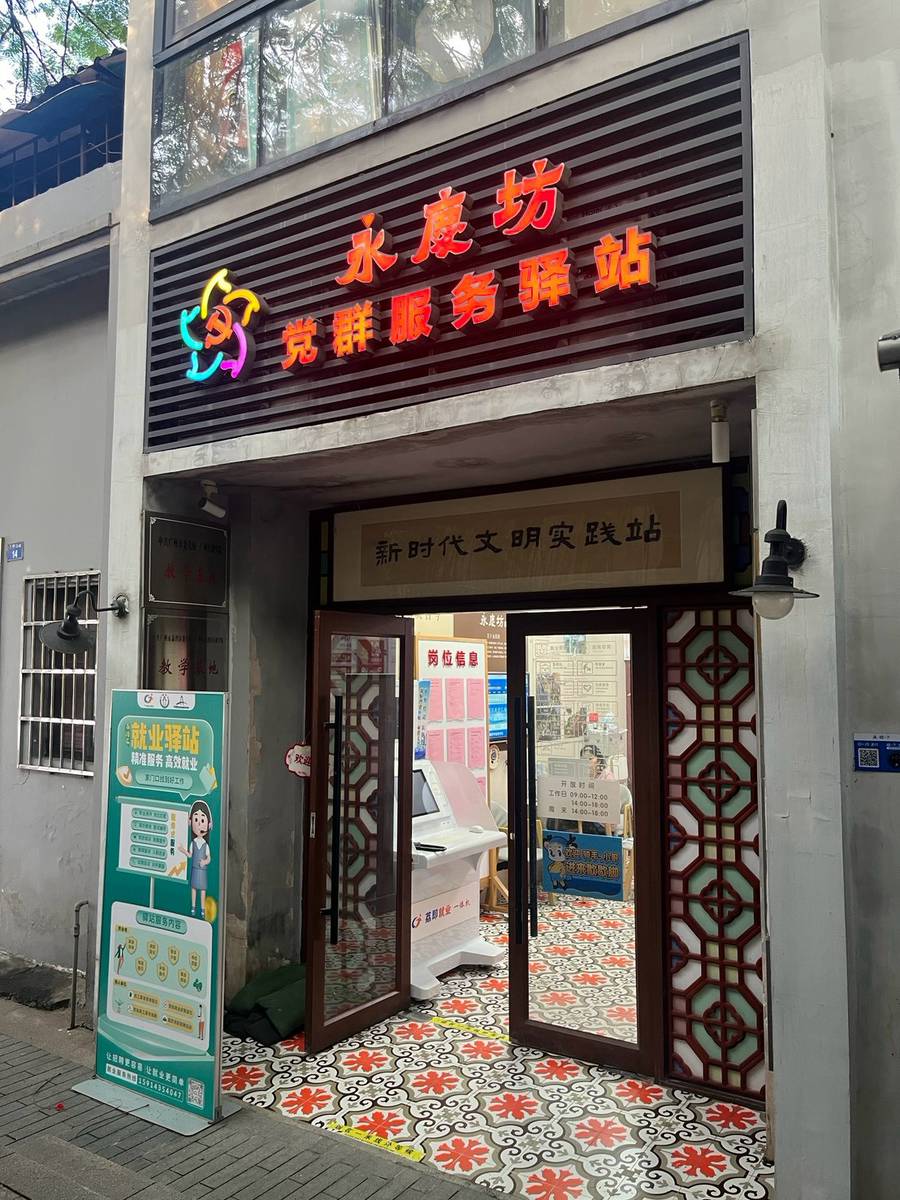
1. Tourist Area Service Station: Yongqing Fang Party-Mass Service Station / New Era Civilization Practice Station, Duobao Subdistrict, Liwan District
Yongqing Fang(永庆坊) is an urban regeneration project in the Enning Road area of Liwan District, Guangzhou, focused on Lingnan culture, Xiguan architecture, Cantonese opera, and Bruce Lee's former residence. It revitalized traditional streets through "micro-renovation," merging traditional streetscapes with cultural facilities, workshop spaces, cafes, and shops, praised as a representative urban renewal model in Guangzhou.
The Yongqing Fang Station was co-located with the New Era Civilization Practice Station in a high-traffic area. It also housed a Hong Kong/Macao service point, community employment station, skill booster station, and labor relations service station. On a weekday evening, the station was staffed by a single young woman and appeared largely ceremonial rather than operational. The two-story building had Party building exhibits, a civic education room, public service counters, and a mother-and-baby room on the first floor. Services included drinking water, phone charging, free Wi-Fi, first aid, umbrella loans, and lost-and-found. Pamphlets on the first floor mostly focused on employment placement for unemployed individuals and high school graduates. The second floor contained activity spaces for Party members (cultural, science, and health rooms). Access to the second floor was restricted, suggesting it was reserved exclusively for Party members.
The co-located Civilization Practice Station aims to educate, publicize, and serve local residents. Led by the residents' committee director under community Party leadership, daily management is handled by professional community staff. Although carrying Party names, daily management appeared practically handled by the residents' committee.
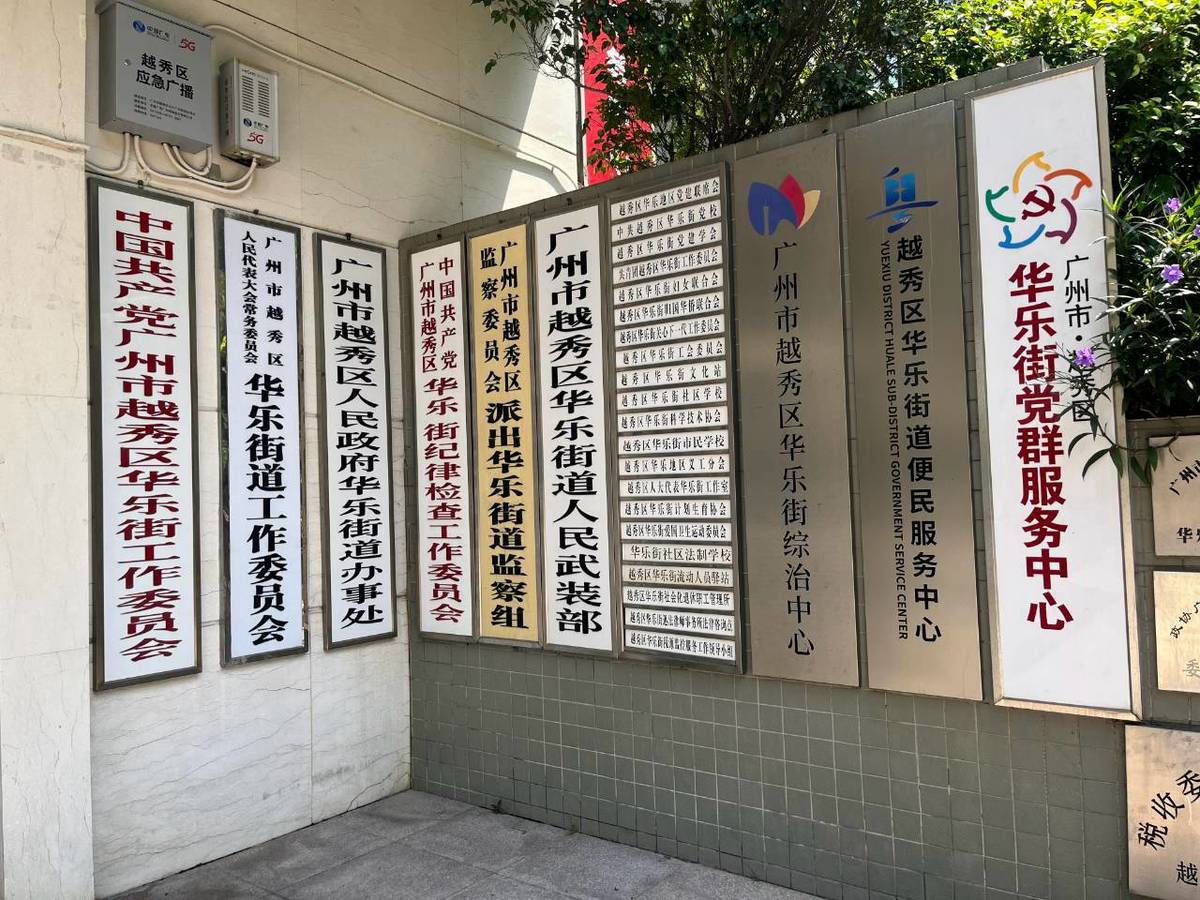
2. Co-located with Multiple Organs: Huale Subdistrict Party-Mass Service Center, Yuexiu District
Huale Subdistrict is an urban residential community in central Guangzhou mixing commercial, residential, and administrative functions. Located along a narrow two-lane road, an independent building housed numerous agencies alongside public security(公安).
The Party-Mass Service Center was co-located with the Huale Subdistrict Party Work Committee, Subdistrict Office, Discipline Inspection Work Committee, Supervisory Group, Armed Forces Department, Comprehensive Governance Center, and Convenience Service Center. Sharing a single entrance next to public security, it was a closed facility where ordinary citizens could not enter without an appointment.
3. Co-located with Residents' Committee: Former Nanhai County Community Party-Mass Service Center, Liurong Subdistrict, Yuexiu District
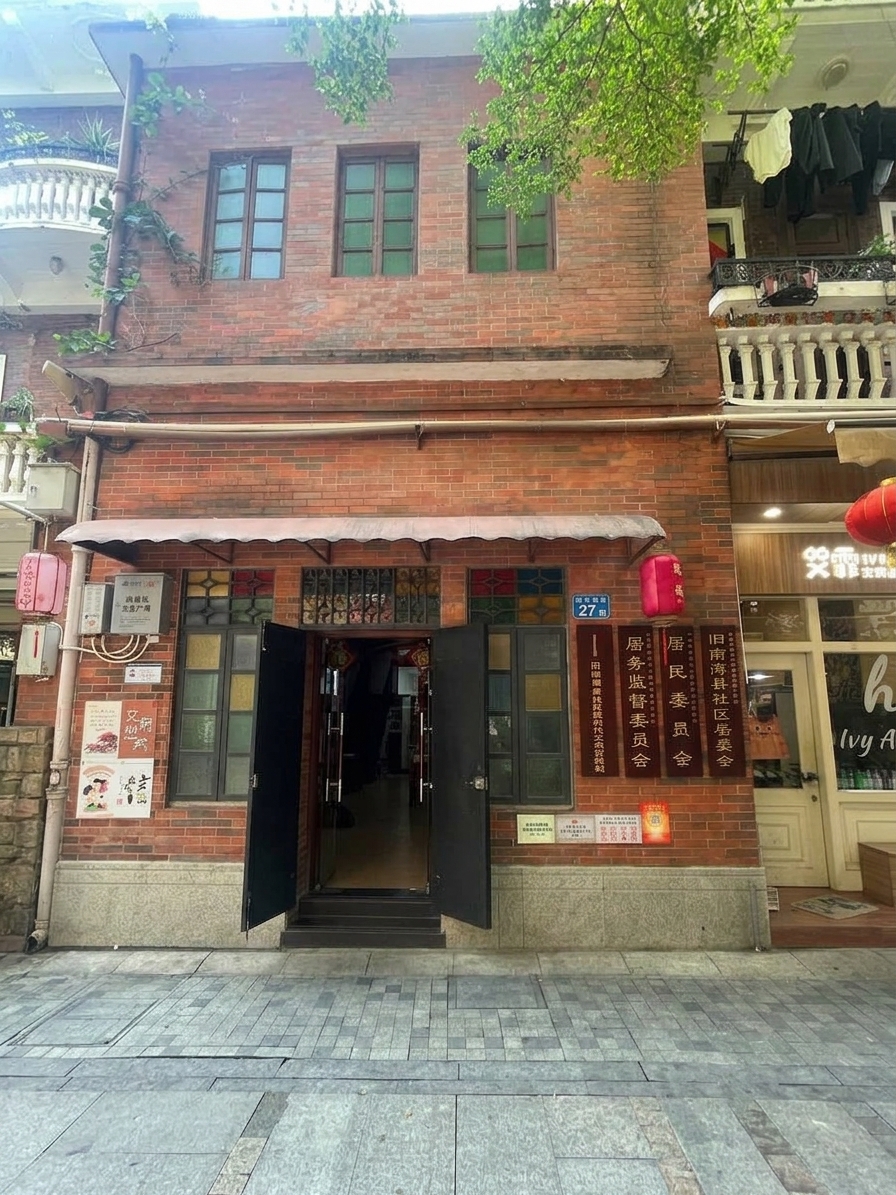
Nanhai County was a historical administrative district under Guangzhou Prefecture. The Former Nanhai County Community retains Republic-era architecture, centered around Huiji West and East Roads, which feature micro-renovated cafes similar to Yongqing Fang. Beyond the main streets lies a mixed area of supermarkets and residential zones.
Signage indicated the Party-Mass Service Center on Huiji West Road, but the physical building read "Former Nanhai County Community Service Center." Handbooks distributed by the residents' committee showed that the residents' committee was responsible for community services. Services covered Party building, civil affairs, health, comprehensive governance, environment, floating population, retirees, employment, culture/education, volunteering, and supervision. While the Party-Mass center was meant to be housed here, it was located at No. 27 Huiji West Road alongside the residents' committee building (He, 2022). Featuring open doors decorated with traditional stained-glass "Manchu windows," it provided an open, accessible space for residents.
5. Issues in Establishment/Operation and Party Control: How Long Can Services Be Maintained?
In grassroots governance, multiple lines of command run in parallel, leaving frontline staff scrambling to respond. Conversations with Chinese citizens reveal general satisfaction with the prompt, accurate responses of grid managers and residents' committees. However, maintaining continuous public satisfaction entails cost and risk. From this perspective, several operational issues arise.
First, an overemphasis on service in operation and activities has led to the neglect of governance (Yuan & Liu, 2026, pp. 70–72). Many Party-Mass Service Centers function primarily as integrated convenience service halls, failing to exercise governance functions. Many services are entertainment-oriented, leaving residents as passive consumers rather than cultivating their capacity to voluntarily participate in grassroots governance.
Second is a shortage of operational funding (Huang, 2023, p. 43). Funding relies heavily on Party building funds and special grants, with insufficient development of social capital. Local government fiscal constraints often impose severe limitations. In one city, construction was delayed due to lack of funds and completed only after receiving donations from the local Industrial and Commercial Bank of China (Huang, 2023, p. 43). In Shanghai, space constraints sometimes force centers to split across multiple locations (Wang, 2025, p. 71). Fund shortages stem fundamentally from the fact that service-oriented work inherently lacks revenue-generating mechanisms. Meeting citizens' demands continuously under these conditions faces distinct limits.
Third is staffing shortages and a lack of proper evaluation systems. Surveys in one city showed high staff turnover and constant understaffing, preventing high-quality service delivery and restricting activities to low-cost, small-scale entertainment events (Huang, 2023, p. 44). At the township level, single evaluation criteria stifle creative work, and a lack of incentive systems dampens staff initiative. Furthermore, despite shortages of specialized personnel, recruitment sometimes fails to match frontline needs (Hou, 2025, pp. 182–183).
By establishing Party-Mass Service Centers that deliver administrative and living services on the foundation of grassroots Party building, the Party is stepping into the forefront to assert a dominant position in grassroots governance. This requires the Party to expand its coverage, maintain social stability, and provide generous services to satisfy the masses. However, without revenue-generating mechanisms, how long can Party-provided services be sustained? If adequate responses can no longer be provided, will the public continue to support the Party? This warrants continued close observation.
References
Communist Party Member WeChat (2024). "What does a Party-Mass Service Center do?" (Jan 4, 2024), 12371.cn, https://www.12371.cn/2024/01/04/ARTI1704363444575550.shtml
General Office of the CPC Central Committee (2019). "Opinions on Strengthening and Improving Urban Grassroots Party Building Work," People's Daily, May 9, 2019, People.cn, http://dangjian.people.com.cn/GB/136058/427510/428086/428095/428550/index.html
General Office of the State Council (2011). "Notice on Printing and Distributing the Community Service System Construction Plan (2011–2015)," Guo Ban Fa [2011] No. 61.
Guangming Daily (2017). "Party building standardization: The 'golden key' to enhancing scientific Party building," April 4, 2017, CPC News Net, http://dangjian.people.com.cn/n1/2017/0404/c117092-29187590.html
He, Bimei. (2022). "Former Nanhai County Community Party-Mass Service Station: Joining hands to build a warm community," Micro-Community e-Express Smart Liurong, https://huacheng.gz-cmc.com/pages/2022/02/23/189db7b24f6c499d8c107690ffd8271d.html
Hou, Guangcheng. (2025). "Analysis of human resource management problems and improvement countermeasures in township Party-Mass Service Centers," Knowledge Economy, 2025(34), 182–185.
Huang, Jian. (2023). "Analysis of the standardized construction of Party-Mass Service Centers," Leadership Science Forum, 2023(11), 42–45.
Ju, Yunpeng. (2024). "Cities have warmth, development adds vitality," People's Daily, Jan 12, 2024.
Nakaoka, Mari. (2026). "Challenges of grid management in Chinese grassroots governance: Organizing multi-layered leadership," Tokiwa Journal of Policy Studies, 17, 103–120.
Social Work Department of the CPC Central Committee. "Department Updates," https://www.zyshgzb.gov.cn/459387/index.html
Tang, Ye. (2023). "'Zero-Distance Home,' a new online celebrity check-in spot in Shanghai," Jiefang Daily, May 15, 2023.
Wang, Xiu. (2025). "Geographical spatial vector: The urban grassroots Party building structure constructed by 'Party-Mass Service Centers'," Journal of the Party School of CPC Fujian Provincial Committee, 2025(3), 68–78.
Wang, Xiu. (2026). "Party-Mass Service Center: Spatial innovation mechanism of urban grassroots Party building," Theory Construction, 2026(2), 62–73.
Xia, Jianzhong. (2019). "From community service to community construction, and then to community governance," Gansu Social Sciences, 2019(6), 24–32.
Xiang, Deping., & Hua, Xunzi. (2019). "The course, evolution and prospect of community construction in China," Journal of the Party School of the Central Committee of the CPC, 23(3), 106–113.
Xu, Xinxin. (2025). From "Residents' Committee" to "Party-Mass Service Center": Governance trends in urban community institutional evolution (Master's thesis, Zhengzhou University).
Yin, Lu., & Yin, Shuo. (2024). "Evolution process and modal analysis of Party-Mass Service Centers: Based on an investigation in Shanghai," Shanghai Party History and Party Building, 2024(5), 98–103.
Yuan, Ke., & Liu, Huayun. (2026). "From service-oriented governance to governance-oriented service: Paths to enhance grassroots governance efficiency," Tianjin Social Sciences, 2026(1), 69–76.
Author Profile

Share & Reference